
Fragrances and Perfumes: How Premium Scent Is Building a USD 106.91 Billion Market


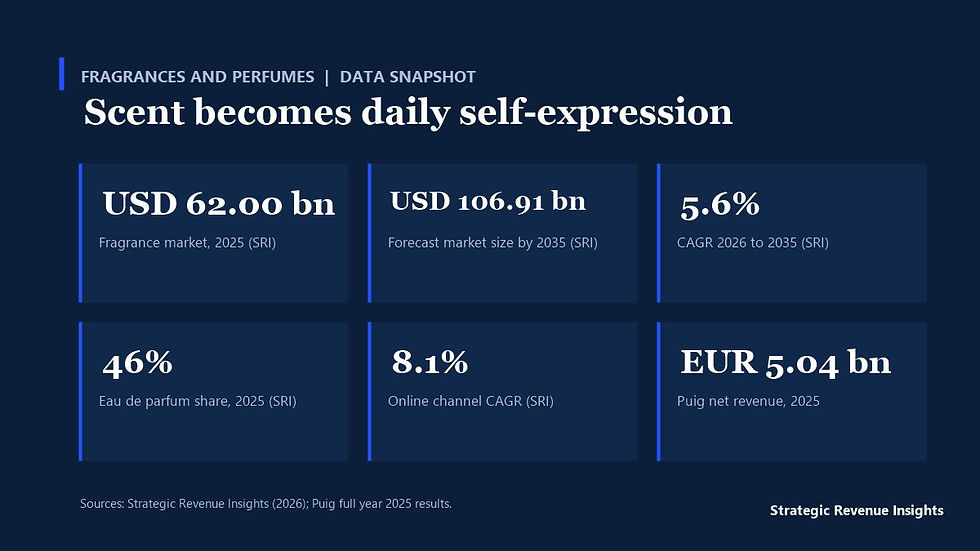
Executive summary. Fragrance used to be a gift category: a bottle bought for birthdays and holidays, chosen from a department store counter. It has become something closer to a daily ritual and a form of self-expression. Younger consumers build wardrobes of scents, layer them, discover them on social media and trade up to niche and luxury bottles, while body mists and smaller sizes open the category to new buyers. Strategic Revenue Insights estimates the global fragrances and perfumes market at USD 62.00 billion in 2025, rising to USD 106.91 billion by 2035 at a 5.6 percent compound annual growth rate. Premiumization, online and social discovery, Middle East and Asian demand and unisex and niche launches are driving it. This article sets out five lessons from the fragrance houses, retailers and brands moving first, with takeaways for strategy, product, operations, channels and revenue.
The structure of the market shows where growth is concentrating. Strategic Revenue Insights' Fragrances and Perfumes Market research finds that eau de parfum is the largest product type at 46.00 percent of 2025 value while attars and oils are the fastest growing at 7.0 percent, that mass fragrance is the largest category at 38.00 percent while luxury is the fastest growing at 6.7 percent, that women's fragrance is the largest gender segment at 47.00 percent while unisex is the fastest growing at 6.8 percent, and that specialty and beauty stores are the largest channel at 34.00 percent while online is the fastest growing at 8.1 percent. Europe is the largest region at 30.00 percent, and Asia Pacific is the fastest growing at 7.4 percent. The research names counterfeits and dupes, allergen and ingredient regulation, weak discretionary spending and natural raw material costs as challenges, and estimates leading shares for L'Oreal at 10.5 percent, LVMH at 8.5 percent, Chanel at 6.5 percent, Estee Lauder at 6.0 percent, Coty at 5.8 percent, Puig at 5.0 percent and Inter Parfums at 3.2 percent.
The leaders' results show fragrance outgrowing much of beauty. Puig, whose business is built mainly on fragrance, reported 2025 net revenue of EUR 5,042 million, up 7.8 percent like for like. In the United States, prestige fragrance dollar sales rose about 5 percent in 2025 and mass fragrance about 15 percent, according to Circana data reported by trade press.
Why the Fragrance Market Is Entering a New Phase
Three structural forces are converging.
Fragrance has become a wardrobe. Consumers own several scents for different moods and occasions and layer them. SRI's research lists fragrance layering and home scent crossovers as an opportunity.
Discovery has moved online. Social media reviews, creator content and online sampling now launch fragrances that once relied on counter testing. SRI's research identifies online as the fastest growing channel and names online and social discovery as a driver.
Growth has shifted east and to the Gulf. The Middle East has a deep perfume culture and high spending per person, while India and Southeast Asia add a growing middle class. SRI's research names Middle East and Asian demand as a driver and Asia Pacific as the fastest growing region.
These forces explain SRI's forecast of steady growth to 2035, with value concentrating in luxury, unisex, online and Asia Pacific.
Five Lessons From the Companies Moving First
The fragrance houses and brands turning these forces into advantage share a recognisable pattern. We have distilled it into five lessons, each followed by a takeaway for a specific leadership function.
Lesson 1: Premiumize, but Keep an Entry Door Open
SRI's research identifies luxury as the fastest growing category and names premiumization as the leading driver. Consumers trade up to higher concentrations, niche houses and limited editions. At the same time, mass fragrance remains the largest category, and body mists and smaller sizes bring in younger and value-conscious buyers.
The companies moving first build ladders: minis, travel sprays and body mists as entry points, eau de parfum as the core, and extrait and collector editions at the top. The premium wellness pattern is similar to the one in the consumer playbook behind the anti-aging and longevity market.
"The customer who buys a body mist at 18 is the customer who buys an extrait at 30. The brand that keeps the door open wins both."
Takeaway on strategy. Build a price ladder from minis and mists to luxury extraits, and use entry formats to recruit younger buyers into the brand.
Lesson 2: Unisex, Niche and Regional Scent Profiles
SRI's research identifies unisex as the fastest growing gender segment and attars and oils as the fastest growing product type. Consumers increasingly choose scents by mood and ingredient rather than by gender, and oud, amber and oil-based fragrances from Middle Eastern traditions are spreading globally.
The companies moving first launch gender-neutral lines, acquire or build niche houses and develop products for Gulf and Asian preferences, such as lighter scents for humid climates and oil formats.
Takeaway on product. Expand unisex and niche ranges, develop attars, oils and regionally inspired profiles, and tailor intensity to climate and culture.
Lesson 3: Secure Ingredients and Comply Early
SRI's research names natural raw material costs and allergen and ingredient regulation as restraints. Vanilla, sandalwood, oud and florals face supply and price swings, while regulators keep tightening allergen labelling and ingredient limits, especially in Europe.
The companies moving first work with fragrance ingredient suppliers on sustainable sourcing, use biotechnology and upcycled ingredients, and reformulate ahead of new rules so launches are not disrupted.
"In fragrance, the formula is the brand. Losing an ingredient to regulation or a bad harvest can mean rewriting a bestseller."
Takeaway on operations. Secure key natural ingredients through long-term and sustainable sourcing, invest in biotech alternatives and track allergen regulation to reformulate early.
Lesson 4: Win Online Discovery and Protect Against Dupes
SRI's research identifies online as the fastest growing channel and names counterfeits and dupes as a challenge. Social media can make a fragrance a bestseller overnight, but it also promotes cheaper look-alike scents and grey-market sales.
The companies moving first invest in creator partnerships, online sampling and discovery sets, and personalised recommendations, while protecting authenticity through selective distribution and brand protection. Subscription and personalisation models also appear in categories such as those described in how humanization is building a USD 219.6 billion pet food market, where emotional connection drives trading up.
Takeaway on channels. Build online discovery through sampling, creators and personalisation, keep specialty and beauty retail strong, and protect the brand against counterfeits and grey-market sales.
Lesson 5: Europe Leads, Asia Pacific and the Gulf Grow Fastest
SRI's research identifies Europe as the largest region and Asia Pacific as the fastest growing, and lists the growing middle class in India and Southeast Asia as an opportunity. The Middle East is a high-value market with its own houses, such as Arabian Oud, which SRI's research names among key companies.
The capabilities that decide who captures this demand are specific:
A price ladder from entry formats to luxury.
Unisex, niche and regionally inspired scent ranges.
Secure, sustainable and compliant ingredient supply.
Online discovery, personalisation and brand protection.
Distribution and product adaptation for Asia and the Gulf.
Companies evaluating these competitive dynamics in greater detail can use SRI's Fragrances and Perfumes Market analysis to assess product, category, gender and channel segments and the positioning of the leading fragrance houses.

Takeaway on market development. Expand in India, Southeast Asia and the Gulf with tailored products, local partners and travel retail, while defending the European base.
Where the Opportunity Is Concentrating
Value is moving toward luxury, unisex, online and Asia Pacific.
By product type, eau de parfum is the largest segment while attars and oils are the fastest growing.
By category, mass is the largest while luxury is the fastest growing.
By gender, women's fragrance is the largest while unisex is the fastest growing.
By channel, specialty and beauty stores are the largest while online is the fastest growing, and by geography Europe leads while Asia Pacific grows fastest.
At the Horizon: What to Watch Over the Next Three Years
Consumer spending. Weak discretionary spending, which SRI's research lists as a challenge, will test whether trading up continues.
Online and social launches. The share of launches driven by social discovery will show how far marketing has shifted.
Ingredient regulation. New allergen and ingredient rules will decide how many formulas need rewriting.
"The next phase of fragrance will be won by the houses that turn a scent into a personal ritual, sold and discovered wherever the customer scrolls."
The Strategic Revenue Opportunity
For fragrance houses, the task is to premiumize while recruiting new buyers. For retailers, the opportunity is discovery, sampling and personalisation. For ingredient suppliers, the priority is secure, sustainable and compliant materials. For investors, the signal is luxury growth, online share and expansion in Asia and the Gulf.
Market intelligence turns these questions into decisions. Segment-level sizing shows where product, category and channel demand is concentrating, competitive analysis shows how fragrance houses are positioned, and regional analysis shows where rising incomes and scent culture will pull growth first. This is the path from market signals to strategic insight to revenue impact.
Takeaway on revenue. Treat the fragrance market as four revenue pools: mass and entry formats sold on accessibility, luxury and niche sold on exclusivity, home and layering products sold on ritual, and online sampling and personalisation sold on discovery. Each needs its own pricing model.
The Next Leg: Preparing for the Journey Ahead
The defining shift in fragrances and perfumes is that scent is moving from occasional gift to daily self-expression. That changes how fragrances are made, discovered and priced. The companies moving first are not the ones with the largest advertising budgets; they are the ones premiumizing with an entry door, expanding unisex and niche, securing ingredients, winning online discovery and growing in Asia and the Gulf.
The next three years will decide which houses define the next generation of signature scents. Decision-makers should invest in product range, ingredients and digital discovery and track spending, social launches and regulation. Companies evaluating growth opportunities in this market can use Strategic Revenue Insights' Fragrances and Perfumes Market report to assess market size, competitive dynamics, regional opportunities and strategic growth priorities.
Sources: Strategic Revenue Insights, Fragrances and Perfumes Market report (2026); Puig full year 2025 results.
Frequently Asked Questions
How big is the fragrances and perfumes market?
Strategic Revenue Insights estimates the global fragrances and perfumes market at USD 62.00 billion in 2025, rising to USD 106.91 billion by 2035 at a 5.6 percent compound annual growth rate. Europe is the largest region at 30.00 percent, while Asia Pacific is the fastest growing.
What is driving growth in fragrances and perfumes?
Premiumization, online and social discovery, demand from the Middle East and Asia, and unisex and niche launches are the main drivers. Consumers are building wardrobes of scents, layering fragrances and trading up to higher concentrations and luxury brands.
Which fragrance segments are growing fastest?
Attars and oils are the fastest growing product type, luxury the fastest growing category, unisex the fastest growing gender segment and online the fastest growing channel, according to Strategic Revenue Insights. Eau de parfum, mass fragrance, women's fragrance and specialty stores remain the largest segments.
Which companies lead the fragrance market?
Strategic Revenue Insights estimates that L'Oreal leads with a 10.5 percent share, followed by LVMH at 8.5 percent, Chanel at 6.5 percent, Estee Lauder at 6.0 percent, Coty at 5.8 percent, Puig at 5.0 percent and Inter Parfums at 3.2 percent.
About the authors: This article was prepared by the Strategic Revenue Insights research team, which combines market intelligence, competitive analysis and strategic advisory for growth-stage, mid-market and enterprise organisations across the consumer goods sector. Sector analyst: Sandeepa Kulkarni, Research Analyst. Our market estimates combine primary research (interviews, surveys and expert panels) with secondary data (industry reports, databases and public disclosures); read more about how Strategic Revenue Insights works. To discuss this market with our analysts, contact our team.


Comments