
Electric Buses: What 70,000 Sales in a Year Mean for a USD 164.61 Billion Market


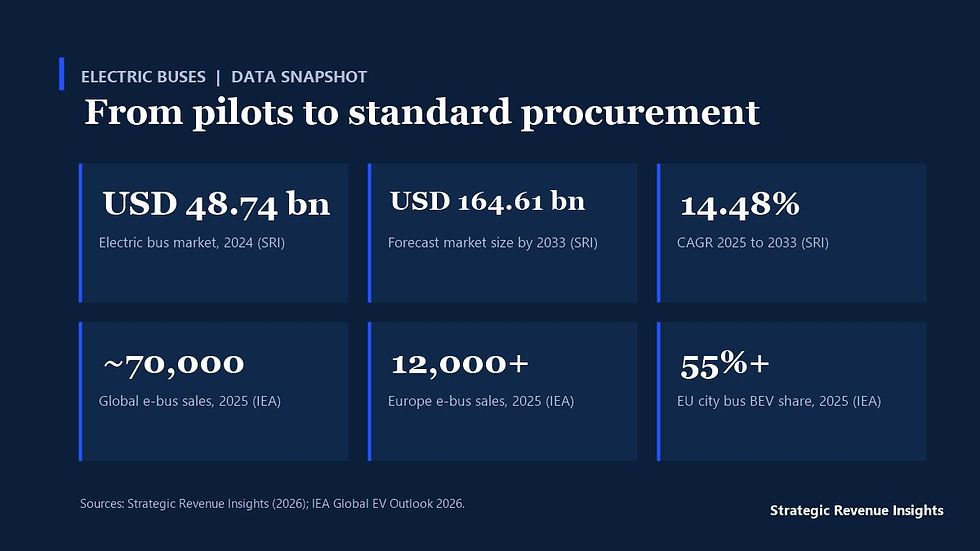
Executive summary. City buses were one of the first vehicle types to go electric at scale, and for good reason: they run fixed routes, return to the same depot every night and spend all day in the streets where air quality matters most. China proved the model a decade ago. Now Europe, Latin America and India are following, and the questions have shifted from whether electric buses work to how to finance, charge and run large fleets. Strategic Revenue Insights projects the global electric bus market to grow from USD 48.74 billion in 2024 to USD 164.61 billion by 2033, at a 14.48 percent compound annual growth rate from 2025. Emission and air quality goals, government subsidies, better batteries and rising fuel costs are driving it. This article sets out five lessons from the bus makers, transit operators and cities moving first, with takeaways for strategy, product, operations, channels and revenue.
The structure of the market shows where value is moving. Strategic Revenue Insights' Electric Bus Market research finds that battery electric buses dominate the market while fuel cell buses are gaining traction, that public transport is the largest application while private fleets and school transport are growing significantly, and that batteries up to 400 kWh currently dominate while larger packs are gaining traction. Asia Pacific leads the market, and the research gives country growth rates of 18 percent for India, 15 percent for China and 14 percent for Brazil. It names high upfront cost, a lack of standardised charging infrastructure and limited range as challenges, and lists BYD, Proterra, Yutong, Volvo Group, Daimler, NFI Group and Tata Motors among the key companies.
Sales data shows the shift continuing. The International Energy Agency's Global EV Outlook 2026 reports that almost 70,000 electric buses were sold worldwide in 2025, up 12 percent, with battery electric powertrains making up 98 percent. Europe sold more than 12,000 electric buses, up 28 percent, and battery electric models took more than 55 percent of new city bus sales in the European Union, up from around 45 percent a year earlier.
Why the Electric Bus Market Is Entering a New Phase
Three structural forces are converging.
Total cost of ownership has turned. Electric buses cost more to buy but less to fuel and maintain. With better batteries and higher diesel prices, many operators now see lower lifetime cost. SRI's research names battery advances and rising fossil fuel costs as drivers.
Cities have set zero-emission deadlines. Clean air zones and procurement rules increasingly require zero-emission buses for new orders. SRI's research names emission reduction and government policy as key drivers.
Charging has become a fleet operation. Depot charging, opportunity charging at route ends and smart energy management now decide whether a fleet runs on time and on budget. SRI's research lists the lack of standardised charging as a challenge.
These forces explain SRI's forecast of strong growth to 2033, with value concentrating in battery electric city buses, charging and emerging markets.
Five Lessons From the Companies Moving First
The bus makers and operators turning these forces into advantage share a recognisable pattern. We have distilled it into five lessons, each followed by a takeaway for a specific leadership function.
Lesson 1: Sell Lifetime Cost, Not Purchase Price
Transit agencies have traditionally bought buses on price per vehicle. Electric buses lose that comparison and win on cost per kilometre over twelve or more years. The makers moving first present total cost of ownership, including energy, maintenance, charging and financing, and help agencies change procurement rules to reflect it.
Financing models such as battery leasing, where the battery is paid for over its life rather than upfront, remove the biggest barrier, which SRI's research names as high upfront cost.
"An electric bus is expensive on the day you buy it and cheap every day after. The sale is won by whoever explains the second part."
Takeaway on strategy. Sell on lifetime cost per kilometre, offer battery leasing and financing, and help agencies adopt total-cost procurement.
Lesson 2: Match Battery Size to the Route
SRI's research identifies packs up to 400 kWh as dominant, with larger batteries gaining traction. Bigger batteries add range but also weight, cost and fewer passengers. The operators moving first model every route, then choose a mix: smaller batteries with opportunity charging for intensive city routes, and larger batteries for longer suburban and intercity routes.
Fuel cell buses, which SRI's research describes as gaining traction, play a role on long routes and in cold or hilly cities where batteries struggle.
Takeaway on product. Offer a range of battery sizes and charging strategies matched to route simulation, and keep fuel cell options for long and demanding routes.
Lesson 3: Charging Is a Depot Redesign
Electrifying a depot means new grid connections, chargers, energy management and often new layouts. The operators moving first plan grid capacity years ahead, use smart charging to avoid peak tariffs and add on-site batteries where grid upgrades are slow. The same grid and utilisation questions shape public charging, as described in what 2.2 million fast chargers mean for the next build-out.
Battery chemistry choices matter too. Lower-cost and safer chemistries, including those covered in how sodium-ion cells open a USD 6.70 billion market, could reduce the cost of both buses and depot storage.
"Buying electric buses is the easy part. Rebuilding the depot around electricity is where projects succeed or stall."
Takeaway on operations. Plan grid capacity early, use smart charging and depot storage, and treat charging as a core operational system with its own uptime targets.
Lesson 4: Offer Buses, Charging and Service as One Package
Transit agencies are not energy companies. The suppliers moving first offer bundled packages: buses, chargers, energy management, maintenance and performance guarantees, sometimes with availability-based payments. Partnerships between bus makers, utilities and charging companies, which SRI's research lists as an opportunity, make these packages possible.
Private fleets and school transport, which SRI's research says are growing significantly, value simple packages even more because they have fewer technical staff.
Takeaway on channels. Bundle buses, charging, energy and maintenance with availability guarantees, and build partnerships with utilities and charging providers.
Lesson 5: Asia Pacific Leads, Emerging Markets Grow Fastest
SRI's research identifies Asia Pacific as the leading region, with India growing at 18 percent and Brazil at 14 percent. China's scale has made its makers, such as BYD and Yutong, global competitors, while India and Latin America use public procurement programmes and multilateral finance to electrify large fleets.
The capabilities that decide who captures this demand are specific:
Lifetime cost proposals with battery leasing and financing.
Battery and charging strategies matched to each route.
Depot electrification, grid planning and smart charging.
Bundled buses, charging and service with guarantees.
Local assembly and finance partnerships in emerging markets.
Companies evaluating these competitive dynamics in greater detail can use SRI's Electric Bus Market analysis to assess type, application and battery capacity segments and the positioning of the leading bus makers.

Takeaway on market development. Pursue India, Latin America and Southeast Asia through local assembly, public procurement programmes and development bank finance.
Where the Opportunity Is Concentrating
Value is moving toward battery electric city buses, charging and emerging markets.
By type, battery electric buses dominate while fuel cell buses are gaining traction.
By application, public transport is the largest while private fleets and school transport are growing significantly.
By battery capacity, packs up to 400 kWh dominate while larger packs are gaining traction.
By geography, Asia Pacific leads, with India, China and Brazil growing fastest.
At the Horizon: What to Watch Over the Next Three Years
Intercity electrification. Progress on longer-range coaches will decide how far electrification reaches beyond city routes.
Battery prices. Lower pack costs will narrow the upfront price gap with diesel.
Emerging market tenders. Large tenders in India, Latin America and Southeast Asia will shape global volumes and supplier rankings.
"The next phase of electric buses will be won by the suppliers who make fleet electrification as easy to buy as a diesel bus."
The Strategic Revenue Opportunity
For bus makers, the task is to compete on lifetime cost and packaged solutions. For transit operators, the opportunity is lower operating cost and cleaner streets. For utilities and charging providers, the priority is depot energy and flexibility. For investors, the signal is order backlogs, financing models and emerging market tenders.
Market intelligence turns these questions into decisions. Segment-level sizing shows where type, application and battery demand is concentrating, competitive analysis shows how bus makers are positioned, and regional analysis shows where policy and finance will pull growth first. This is the path from market signals to strategic insight to revenue impact.
Takeaway on revenue. Treat the electric bus market as four revenue pools: buses sold on lifetime cost, batteries sold or leased, charging and energy services sold to depots, and maintenance and availability contracts sold over the fleet life. Each needs its own pricing model.
The Next Leg: Preparing for the Journey Ahead
The defining shift in electric buses is that they are moving from pilot fleets to standard procurement. That changes how buses are bought, financed and operated. The companies moving first are not the ones with the cheapest buses; they are the ones selling lifetime cost, matching batteries to routes, redesigning depots, bundling service and expanding in emerging markets.
The next three years will decide which suppliers become the default partners for zero-emission transit. Decision-makers should invest in financing, charging and service capability and track intercity electrification, battery prices and emerging market tenders. Companies evaluating growth opportunities in this market can use Strategic Revenue Insights' Electric Bus Market report to assess market size, competitive dynamics, regional opportunities and strategic growth priorities.
Sources: Strategic Revenue Insights, Electric BUS Market report (2026); IEA Global EV Outlook 2026.
Frequently Asked Questions
How big is the electric bus market?
Strategic Revenue Insights projects the global electric bus market to grow from USD 48.74 billion in 2024 to USD 164.61 billion by 2033, at a 14.48 percent compound annual growth rate from 2025. Asia Pacific leads the market, and battery electric buses dominate.
What is driving growth in electric buses?
Efforts to cut greenhouse gas emissions and improve urban air quality, government policies and subsidies, advances in battery technology, rising fossil fuel costs and awareness of diesel pollution are the main drivers. Lower lifetime operating costs are also making electric buses attractive to operators.
Which electric bus segments are growing fastest?
Battery electric buses dominate, while fuel cell buses are gaining traction, according to Strategic Revenue Insights. Public transport is the largest application, while private fleets and school transport are growing significantly. India, China and Brazil show the highest country growth rates in the research.
What are the main challenges for electric buses?
The main challenges are the high upfront cost compared with diesel buses, the lack of standardised charging infrastructure and limited range on longer routes. Battery leasing, depot planning and smart charging are helping operators overcome these barriers.
About the authors: This article was prepared by the Strategic Revenue Insights research team, which combines market intelligence, competitive analysis and strategic advisory for growth-stage, mid-market and enterprise organisations across the automotive and logistics sector. Sector analyst: Anirudh Singh, Research Analyst. Our market estimates combine primary research (interviews, surveys and expert panels) with secondary data (industry reports, databases and public disclosures); read more about how Strategic Revenue Insights works. To discuss this market with our analysts, contact our team.


Comments