
Activated Carbon: How PFAS Rules Are Turning a Commodity Into a Strategic Material

Updated: 4 days ago

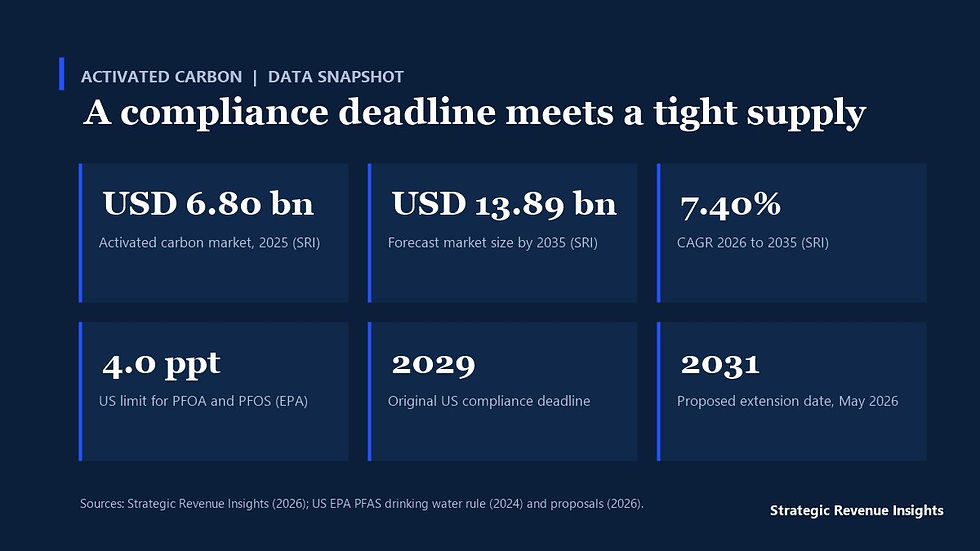
Executive summary. Activated carbon has been filtering water and air for more than a century, and for most of that time it was a commodity bought on price per tonne. In 2026 it is becoming strategic. New limits on PFAS in drinking water, tighter air emission rules and industrial purification needs are raising demand faster than capacity, and the raw material base is shifting from coal to coconut shell and wood. Strategic Revenue Insights estimates the global activated carbon market at USD 6.80 billion in 2025, rising to USD 13.89 billion by 2035 at a 7.40 percent compound annual growth rate. Demand for water treatment and air purification, urbanisation and industrialisation, production technology, renewable raw materials and stringent emission and water quality regulation are driving it. This article sets out five lessons from the producers, utilities and industrial users moving first, with takeaways for strategy, supply, technology, service and revenue.
The structure of the market explains where value is moving. Strategic Revenue Insights' Activated Carbon Market research finds that powdered activated carbon is the largest type while granular activated carbon is the fastest growing, that water treatment is the largest application, that coal has traditionally dominated raw materials while coconut shell and wood are gaining share, and that Asia Pacific is both the largest and the fastest growing region. The research names demand for water treatment and air purification, urbanisation and industrialisation, advances in production technology, sustainability and renewable raw materials and stringent emissions and water quality regulation as drivers, and regulatory hurdles, supply chain disruption, raw material availability and price swings and intense competition as challenges. It lists Calgon Carbon, Cabot, Jacobi Carbons, Haycarb, Ingevity, Donau Carbon and Kureha among the leading companies.
Regulation is the clearest demand signal. The United States Environmental Protection Agency's 2024 drinking water rule set enforceable limits of 4.0 parts per trillion for PFOA and PFOS, with a compliance deadline in 2029, and granular activated carbon is one of the named treatment technologies alongside ion exchange resins and high-pressure membranes. In May 2026 the agency proposed allowing eligible systems to apply for extensions to 2031 and rescinding the limits for several other PFAS compounds, while leaving the PFOA and PFOS limits unchanged. Arq, a carbon producer, said in 2024 that it expected the rule to drive a three to five times or greater increase in water-related granular carbon demand over the coming years, a company forecast that predates the 2026 proposals. Whatever the final timeline, utilities are planning carbon systems now.
Why the Activated Carbon Market Is Entering a New Phase
Three structural forces are converging.
Regulation has created a deadline-driven demand wave. Drinking water limits for PFAS, air emission rules for mercury and volatile organic compounds, and industrial discharge standards all specify treatment performance that carbon can deliver. SRI's research names stringent emissions and water quality regulation as a driver. A municipal utility facing a compliance date does not shop on price alone; it shops on proven performance, supply certainty and the service to replace and reactivate spent carbon.
Granular systems are replacing powdered dosing. Powdered carbon dosed into water remains the largest type in SRI's research, but granular carbon in fixed beds is the fastest growing because it removes contaminants such as PFAS more reliably and can be reactivated and reused. That shift moves the business from selling a consumable to installing a system with a long service tail.
The raw material base is changing. Coal-based carbon dominates, but coconut shell and wood-based carbons are gaining share on performance in some applications and on sustainability credentials. SRI's research names renewable raw materials as both a driver and an opportunity, and raw material availability and price volatility as a challenge.
These forces explain SRI's forecast of a market that roughly doubles between 2025 and 2035, with value concentrating in granular systems, water treatment and Asia Pacific.
Five Lessons From the Companies Moving First
The producers, utilities and industrial users turning these forces into advantage share a recognisable pattern. We have distilled it into five lessons, each followed by a takeaway for a specific leadership function.
Lesson 1: Sell Compliance, Not Tonnes
The traditional activated carbon sale quoted a price per tonne. The companies growing fastest in SRI's research sell a compliance outcome: a guaranteed treatment level for a contaminant, proven in pilot testing, delivered by a designed system and maintained by a service contract. For a utility or an industrial plant facing a regulatory limit, that outcome is worth far more than the carbon itself.
That changes the sale. Producers offer pilot testing and modelling to size beds, engineering support to design systems, and contracts that cover supply, change-out and reactivation over many years. It also changes the competitive set, because carbon now competes with ion exchange resins and membranes on total cost of compliance, not just on carbon price. A 2026 market analysis cited a PFAS-selective resin cost of about USD 0.26 per thousand gallons treated against about USD 0.45 for granular carbon, which shows why carbon suppliers must sell lifecycle value and reactivation economics rather than unit price.
"A utility facing a PFAS deadline is not buying carbon. It is buying the certainty that its water will pass the test every quarter for the next twenty years."
Takeaway on strategy. Reposition from tonnes to treatment outcomes: offer pilot testing, system design and multi-year supply, change-out and reactivation contracts. Build the comparison against resin and membrane alternatives on total cost of compliance, including reactivation and disposal.
Lesson 2: Secure Raw Material and Capacity Ahead of the Wave
A deadline-driven demand wave meets a capacity-constrained industry. Arq described the PFAS rule in 2024 as exacerbating a supply shortage already present in the granular carbon market. SRI's research names raw material availability and supply chain disruption as challenges. The producers moving first secure raw material through long-term contracts and backward integration, add activation and reactivation capacity, and diversify across coal, coconut shell and wood so that one feedstock shock cannot stop production.
Location matters too. Water utilities and governments increasingly prefer domestic or regionally secure supply for critical treatment chemicals, which favours producers with plants close to demand.
The supply chain discipline is the same that we described in the advanced carbon materials supply chain strategy, where feedstock security has become a competitive advantage in its own right.
Takeaway on supply. Lock in raw material through long-term contracts and integration, diversify across coal, coconut shell and wood, and invest in activation and reactivation capacity close to major demand regions before compliance deadlines arrive.
Lesson 3: Engineer the Carbon for the Contaminant
Not all activated carbon performs the same. Pore structure, surface chemistry and particle size determine which contaminants a carbon removes and how long a bed lasts before breakthrough. The companies moving first engineer carbons for specific targets: short-chain and long-chain PFAS, mercury in flue gas, specific volatile organic compounds, taste and odour, and process purification in food, pharmaceuticals and chemicals.
SRI's research names advances in production technology as a driver. Those advances include tailored activation, impregnated carbons for specific gases and catalytic carbons that break down contaminants. Engineered products carry higher margins and are harder to substitute.
The same performance-led approach applies in air. Indoor and industrial air purification, discussed in how the air purifier became an indoor air quality subscription, relies heavily on activated carbon for gases and odours that particle filters cannot capture.
"The commodity is the coal. The product is the pore structure, and the pore structure is what decides whether a bed lasts six months or eighteen."
Takeaway on technology. Invest in engineered carbons tailored to priority contaminants, prove performance with bed-life data and pilot results, and price specialty grades on the treatment cost they save rather than on weight.
Lesson 4: Reactivation Is the Recurring Revenue
Spent granular carbon can be thermally reactivated and returned to service, which cuts cost, reduces waste and, in the case of PFAS, destroys the captured contaminants at high temperature. The companies moving first build reactivation into the business model: collecting spent carbon, reactivating it in their own furnaces, and returning it to the same customer under a long-term contract.
Reactivation turns a one-time sale into recurring revenue, deepens the customer relationship and creates a barrier for competitors without reactivation capacity. It also addresses the sustainability question, because reactivated carbon has a far lower footprint than virgin material. SRI's research names sustainable production as an opportunity.
Destruction matters for PFAS in particular. Utilities and regulators want assurance that captured contaminants are not simply moved to landfill, and verified thermal destruction is becoming a requirement in contracts.
Takeaway on service. Build reactivation capacity and logistics as a core service, offer closed-loop contracts that return reactivated carbon to the same customer, and document contaminant destruction to meet utility and regulator expectations.
Lesson 5: Follow Urbanisation and Regulation Into Asia Pacific
SRI's research identifies Asia Pacific as both the largest and the fastest growing region, driven by urbanisation, industrialisation and tightening water and air standards. The region is also home to much of the world's coconut shell supply, which gives local producers a raw material advantage. The companies moving first expand capacity and service networks in the region and position engineered products for municipal water, industrial wastewater and air quality programmes.
At the same time, North America and Europe are the leading markets for regulation-driven granular systems, especially for PFAS. A global portfolio balances fast volume growth in Asia Pacific with high-value compliance business in mature markets.
The capabilities that decide who captures this demand are specific:
A compliance-led proposition with pilot testing, design and long-term contracts.
Secure raw material and activation capacity across feedstocks.
Engineered carbons for priority contaminants.
Reactivation and verified destruction as recurring services.
A footprint that balances Asia Pacific growth with mature-market compliance demand.
Companies evaluating these competitive dynamics in greater detail can use SRI's Activated Carbon Market analysis to assess type, raw material and application segments and the positioning of the leading producers.

Takeaway on market development. Expand capacity and service networks in Asia Pacific to capture volume growth, while building high-value granular and reactivation businesses in North America and Europe where PFAS compliance is driving demand.
Where the Opportunity Is Concentrating
Value is moving toward granular systems, water treatment and engineered products.
By type, powdered activated carbon is the largest segment on volume and flexibility, granular activated carbon is the fastest growing on PFAS and fixed-bed treatment, and pelletised and specialty forms serve gas phase and industrial uses.
By raw material, coal remains dominant, while coconut shell and wood are gaining share on performance and sustainability.
By application, water treatment is the largest segment, air and gas purification is expanding with emission rules, and food, pharmaceutical and industrial purification offer high-value niches.
By geography, Asia Pacific is the largest and fastest growing region, North America is the hub of PFAS-driven granular demand, and Europe is shaped by water and air quality directives.
At the Horizon: What to Watch Over the Next Three Years
The final PFAS timeline. The outcome of the 2026 proposals on extensions and rescinded limits will shape when and how much granular carbon utilities buy.
Resin and membrane competition. Cost and performance comparisons with ion exchange resins will decide carbon's share of PFAS treatment, especially for short-chain compounds.
Capacity additions. New activation and reactivation plants, and their location, will determine whether supply keeps pace with compliance demand.
"The next phase of activated carbon will not be decided by who sells the cheapest tonne. It will be decided by who guarantees the treatment, secures the supply and closes the loop on spent carbon."
The Strategic Revenue Opportunity
For producers, the task is to move from commodity sales to compliance systems with reactivation services. For utilities and industrial users, the priority is to secure supply and service early. For equipment and engineering firms, the opportunity is in system design and installation. For investors, the signal is in granular capacity, reactivation networks and regulatory timelines.
Market intelligence turns these questions into decisions. Segment-level sizing shows where type and application demand is concentrating, competitive analysis shows how producers are positioned, and regional analysis shows where regulation and urbanisation will pull demand first. This is the path from market signals to strategic insight to revenue impact.
Takeaway on revenue. Treat the activated carbon market as four revenue pools: powdered carbon sold on dosing flexibility, granular systems sold on compliance outcomes, reactivation and destruction services sold on recurring contracts, and specialty engineered carbons sold on performance. Each needs its own pricing model. Grow granular and reactivation share where regulation is tightening.
The Next Leg: Preparing for the Journey Ahead
The defining shift in activated carbon is that regulation has turned a commodity into a compliance-critical material. That changes how it is sold, how supply is secured and where value accumulates. The companies moving first are not the ones with the lowest price per tonne; they are the ones selling compliance, securing raw material, engineering carbons for contaminants, building reactivation and following regulation and urbanisation.
The next three years will decide which producers become long-term treatment partners to utilities and industry. Decision-makers should reposition around outcomes, secure capacity, invest in engineered products and reactivation, and track the regulatory decisions that will set the demand curve. Companies evaluating growth opportunities in this market can use Strategic Revenue Insights' Activated Carbon Market report to assess market size, competitive dynamics, regional opportunities and strategic growth priorities.
Sources: Strategic Revenue Insights, Activated Carbon Market report (2026); US EPA PFAS drinking water rule (2024) and proposals (2026).
Frequently Asked Questions
How big is the activated carbon market?
Strategic Revenue Insights estimates the global activated carbon market at USD 6.80 billion in 2025, rising to USD 13.89 billion by 2035 at a 7.40 percent compound annual growth rate.
How are PFAS rules affecting activated carbon?
New limits on PFAS in drinking water, along with tighter air emission rules and industrial purification needs, are raising demand for activated carbon faster than capacity, turning a commodity into a strategic material.
Which activated carbon segments lead?
Powdered activated carbon is the largest type and granular activated carbon the fastest growing. Water treatment is the largest application, coconut shell and wood are gaining share over coal, and Asia Pacific is the largest and fastest growing region.
Who are the leading activated carbon companies?
SRI's research lists Calgon Carbon, Cabot, Jacobi Carbons, Haycarb, Ingevity, Donau Carbon and Kureha among the leading companies.
About the authors: This article was prepared by the Strategic Revenue Insights research team, which combines market intelligence, competitive analysis and strategic advisory for growth-stage, mid-market and enterprise organisations across the chemicals and materials sector. Sector analyst: Rohan Mehta, Principal Strategist, Finance, Chemicals and Market Risk. Our market estimates combine primary research (interviews, surveys and expert panels) with secondary data (industry reports, databases and public disclosures); read more about how Strategic Revenue Insights works. To discuss this market with our analysts, contact our team.


Comments